
At a dental visit the dentist may request a panoramic or a periapical film. The two give different information and complement each other.
- A panoramic film shows the whole jaw at once, while a periapical film shows a few teeth in more detail.
- Panoramic films are often used for wisdom teeth, impacted teeth and planning replacement of missing teeth.
- Periapical films are often used when decay may have reached the pulp, an abscess is suspected, or during root canal treatment.
- The two types complement each other and the dentist chooses based on each case.
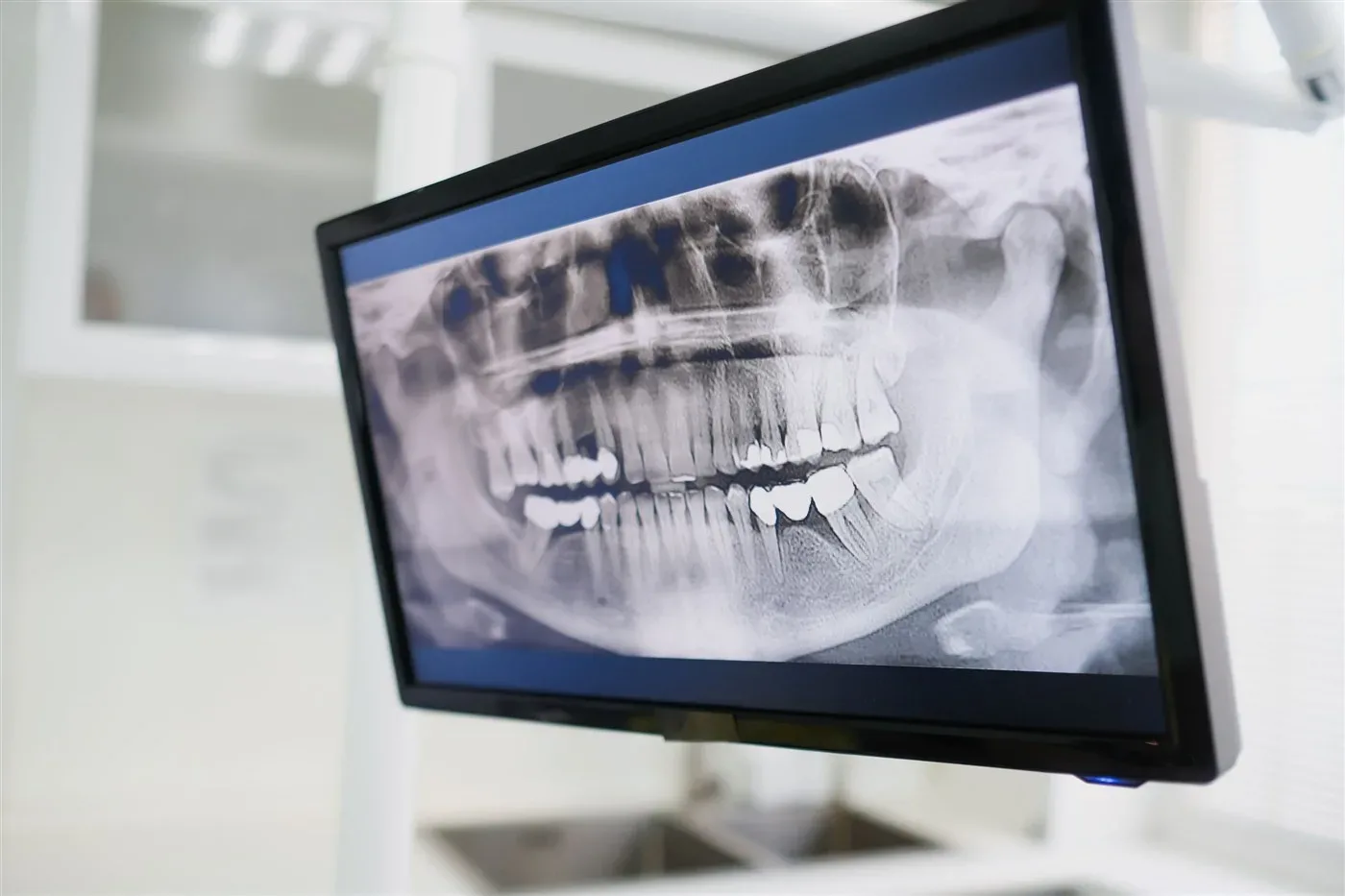
What is a panoramic X-ray?
A panoramic X-ray is a single wide image that shows the upper and lower jaws, the teeth, the jawbone and the position of the wisdom teeth together. It gives the dentist an overall view of the whole jaw.
What is a periapical X-ray?
A periapical X-ray covers only a few teeth, but shows the whole tooth including the root and the bone around the root tip. The image is more detailed and is usually used to look at one tooth that has a problem.
How do the two differ?
- Coverage: a panoramic shows the whole jaw, a periapical shows only a few teeth.
- Detail: a periapical is sharper for individual teeth, while a panoramic is less detailed but broader.
- Purpose: a panoramic gives a general assessment, a periapical lets the dentist examine one tooth closely.
When does the dentist use a panoramic film?
- To see where the wisdom teeth lie, especially when an impacted tooth is suspected. See our article on what an impacted tooth is.
- When planning replacement of missing teeth or an implant, where the jawbone must be assessed.
- To get an overall picture of the teeth and jaw before treatment.
When does the dentist use a periapical film?
- When decay may have reached the pulp or there may be an abscess at the root tip. See our article on how to tell if decay has reached the pulp.
- During root canal treatment to check the root canals.
- To look closely at a tooth after a filling, an extraction or an injury.
Is having an X-ray harmful?
The radiation dose of dental films is very low and the dentist requests them only when needed. You may read whether dental X-rays are harmful for peace of mind. Each person needs different films, and the dentist decides after examining you.
You are welcome to walk in during opening hours at Nha Khoa Kỳ Hòa, 266A - 268, 3 Tháng 2 Street, Hòa Hưng Ward, Ho Chi Minh City, or call the hotline 028.3868.1097 (Zalo 082.299.3377) to ask about quieter time slots.
Frequently asked questions
Can a panoramic film replace a periapical film?
Not completely. A panoramic gives the overall view and a periapical gives more detail on individual teeth. The two often complement each other.
Which film is used for wisdom teeth?
A panoramic film is commonly used to see where wisdom teeth lie and in which direction. The dentist chooses the suitable film for each case.
Can a pregnant woman have a dental X-ray?
Please tell the dentist you are pregnant so the dentist can weigh whether the film is really needed and use suitable protection.