
Floss cleans the gaps between teeth that a toothbrush cannot reach. Using it the wrong way can hurt the gum, so it helps to know a few simple steps.
- Floss cleans the gaps between teeth that a toothbrush cannot reach.
- Hold the floss taut, ease it past the contact point, curve it in a C shape around the tooth and use a clean section for each gap.
- Avoid pressing hard into the gum and avoid snapping the floss through.
- Mild bleeding in the first days usually improves; bleeding that continues should be examined.
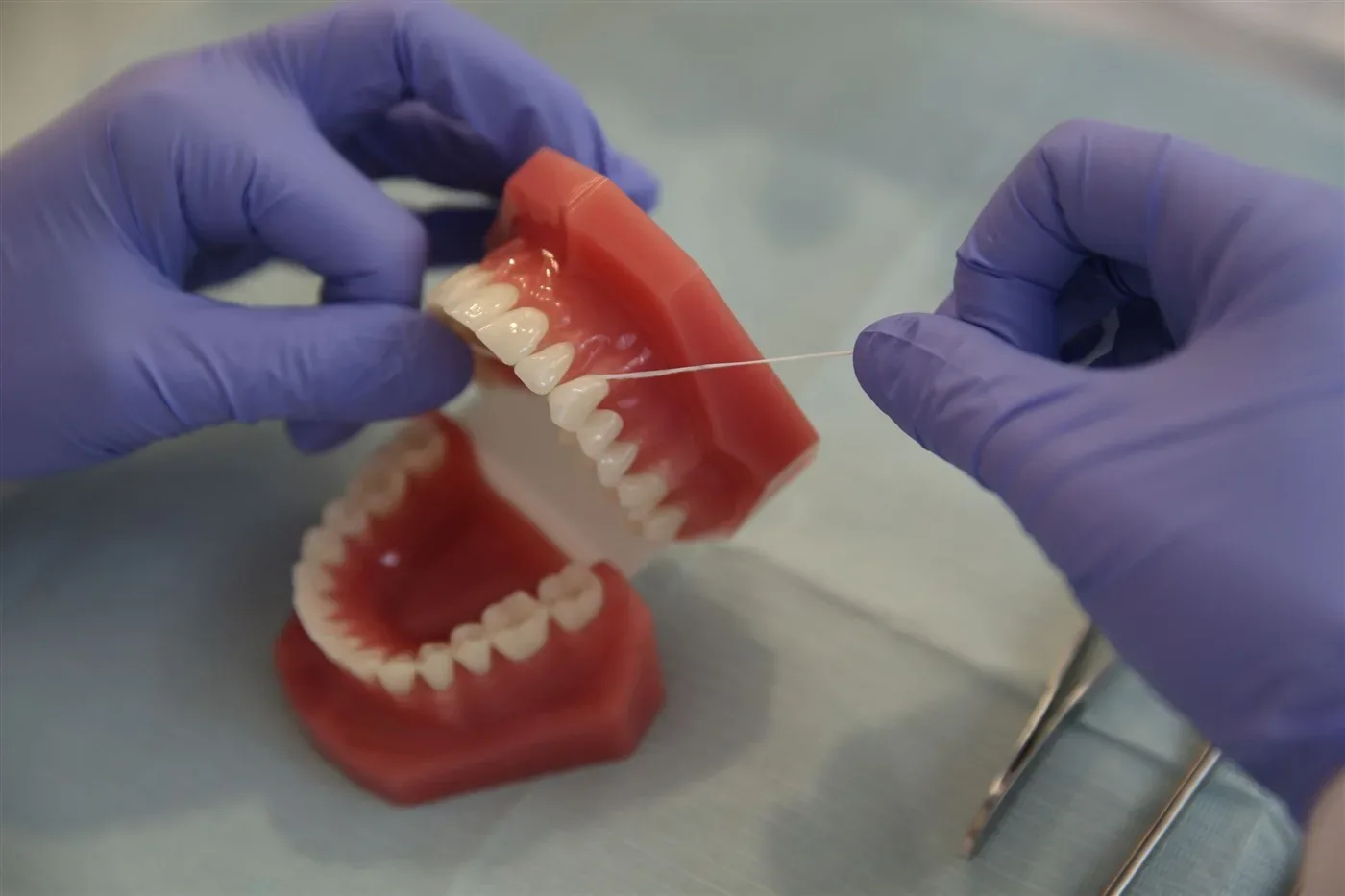
Why use floss at all?
A toothbrush cleans the outer, inner and chewing surfaces of teeth. The gap between two teeth collects plenty of plaque, but a brush hardly gets in. Floss removes that plaque and lowers the risk of decay between teeth and of gum inflammation. You can read more in our article on brushing properly and whether floss is needed.
Steps for using floss
- Take about 40 cm of floss and wind the two ends around your middle fingers, leaving about 3 to 4 cm in the middle to work with.
- Hold the floss taut with your thumbs and index fingers, and guide it into the gap with a gentle back and forth motion, without pushing hard onto the gum.
- Once the floss passes the contact point, curve it around one tooth in a C shape and slide it gently up and down the side of the tooth, just slightly under the gum edge.
- Repeat on the neighbouring tooth in the same gap, then draw the floss out.
- Move to a clean section of floss for the next gap, and do not reuse a dirty section.
Common mistakes
- Pressing the floss hard into the gum, which cuts the gum and makes it sore and bleed.
- Snapping the floss past the contact point instead of easing it through gently.
- Not hugging the tooth, so the floss runs straight and removes no plaque.
- Reusing the same section for several gaps, carrying bacteria from one gap to the next.
What if the gums bleed at first?
In the first days many people notice mild bleeding because the gums are already inflamed from long standing plaque. If you floss correctly and regularly, this usually improves over time. If the bleeding is heavy or continues, it is wise to be examined, and you may read about what gingivitis is and whether it clears on its own.
When might another tool suit you better?
If your gaps are wide, you have a bridge, or winding floss is awkward, you can use interdental brushes or floss picks. A water flosser can add extra help, and we have an article on whether it can replace floss. The dentist can advise the right tool when you visit.
You are welcome to walk in during opening hours at Nha Khoa Kỳ Hòa, 266A - 268, 3 Tháng 2 Street, Hòa Hưng Ward, Ho Chi Minh City, or call the hotline 028.3868.1097 (Zalo 082.299.3377) to ask about quieter time slots.
Frequently asked questions
Should I floss before or after brushing?
Either works. What matters is doing it every day, at least once, usually in the evening before bed.
Does flossing make gaps between teeth wider?
Gentle, correct flossing does not widen gaps. Gaps usually widen because of receding gums or long standing plaque, not because of floss.
Are floss picks effective?
Floss picks are handy away from home or when winding floss is hard. Use one for each gap and change the head often.