
Old retained roots may not hurt, but they can still harbour bacteria, cause silent inflammation or abscesses and press on dentures. Some firm roots can be kept, and the dentist will examine and take an X-ray to decide.
- Old retained roots may not hurt but can still cause silent infection and abscesses.
- Firm roots with good bone can be root-treated and crowned or used to support a denture.
- Loose roots, deeply broken roots or those with large infections are better removed.
- People with health conditions should bring their prescriptions and not stop medicines on their own.
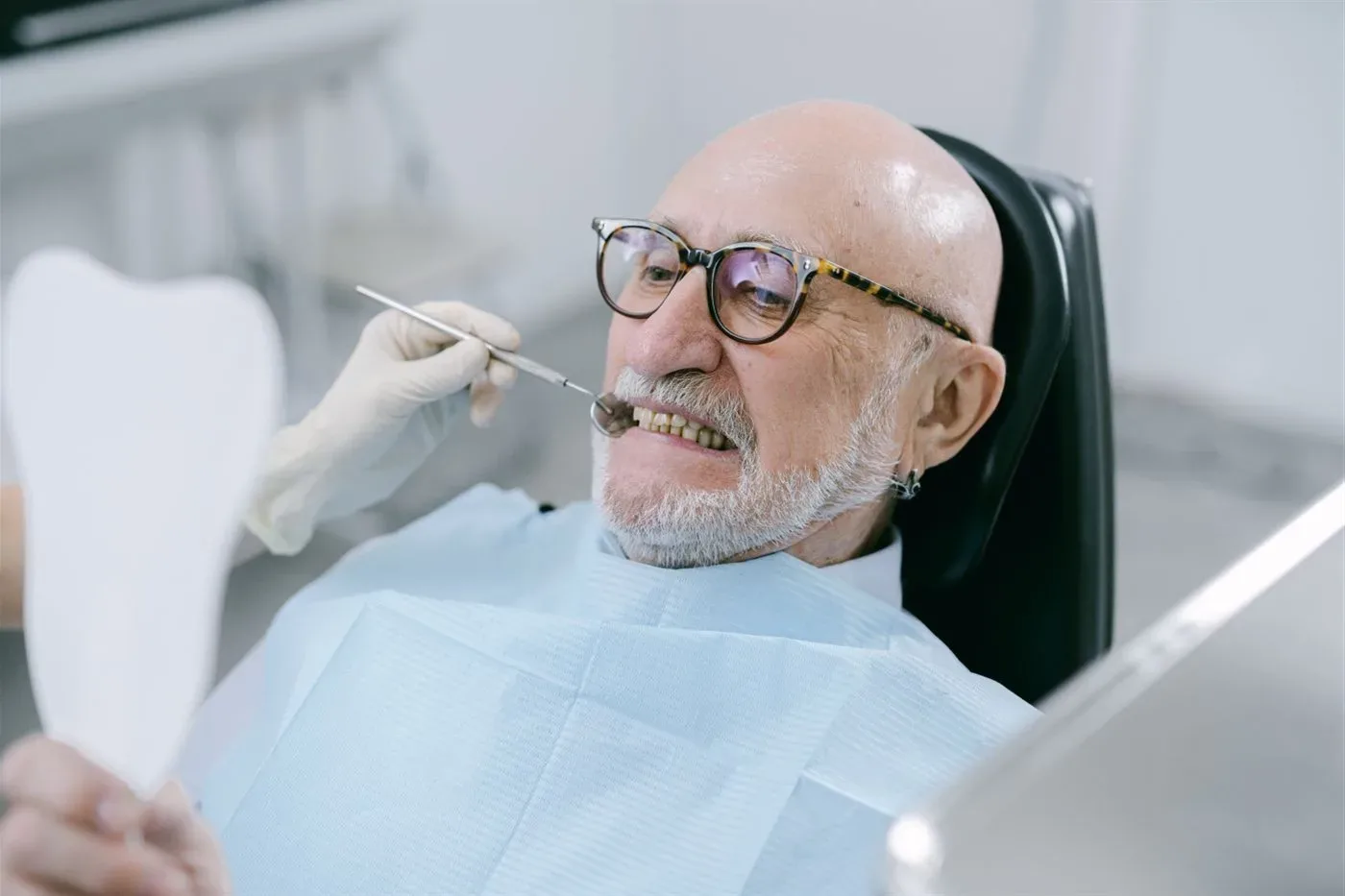
Many older adults have decayed teeth that broke down long ago and now only a dark root remains at the gum line. Because it does not hurt, it is often left for years, sometimes with a denture sitting over it. So do these roots need to be removed?
What harm can retained roots cause?
- Silent inflammation: the nerve has died so there is no pain, but bacteria inside the root canal can cause inflammation at the root tip and bone loss in the jaw.
- Abscess and cheek swelling: when the body's defences are low, the infection can flare into an abscess. See swollen cheek from a tooth abscess.
- Bad breath and gum inflammation: sharp, rough root edges trap food easily.
- Problems with dentures: roots gradually rising can tilt a removable denture, causing pain and gum ulcers.
- Cheek and tongue ulcers: sharp edges rubbing the lining of the mouth over time cause sores that are slow to heal and need monitoring.
- Effects on general health: a chronic infection in the mouth is not good for people with diabetes or heart disease.
When can a root be kept?
Not every root has to be removed. If the root is firm, long enough, with healthy surrounding bone and no severe infection, the dentist may do root canal treatment and then:
- Place a post and crown so the tooth can be used for chewing again.
- Or seal the root so it can support a denture placed over it, which helps preserve bone and keeps the denture more stable.
When is extraction better?
- The root is loose or broken deep below the gum, with too little tooth left to restore.
- An X-ray shows a large area of infection around the root tip.
- There have been repeated swellings or abscesses.
- The root gets in the way of making a new denture. See full dentures.
You can also read removing a broken decayed tooth and keep or remove a loose tooth.
What should older adults with health conditions prepare?
- Bring your medical records and current prescriptions, and tell the dentist about heart disease, diabetes, blood pressure, blood thinners or osteoporosis medicines.
- Do not stop any medicines on your own before an extraction; the dentist will coordinate with your doctor when needed.
- Eat a light meal before coming, sleep well the night before and bring a family member.
See also extractions for people with heart disease or diabetes.
Nha Khoa Ky Hoa is at 266A - 268, 3 Thang 2 Street, Hoa Hung Ward, Ho Chi Minh City. Hotline 028.3868.1097, Zalo 082.299.3377 to ask about quieter times.
Frequently asked questions
If a root does not hurt, should I still worry about it?
Yes. Roots with a dead nerve often do not hurt but can still be infected. A check-up and X-ray will show what is going on.
Can an 80-year-old have a root removed?
Age alone is not a reason to avoid extraction. What matters is that health conditions are under control and the dentist assesses the patient carefully first.
Can a denture be placed over a root?
Only when the root has had root canal treatment and is well sealed. An infected root should not be covered by a denture.